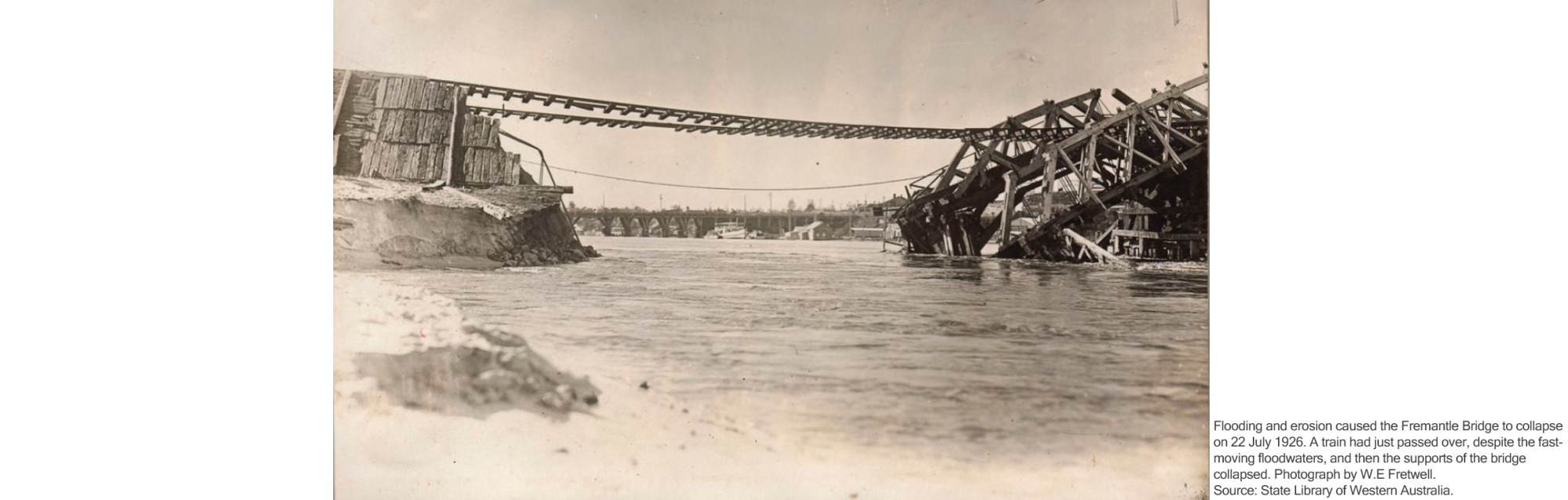
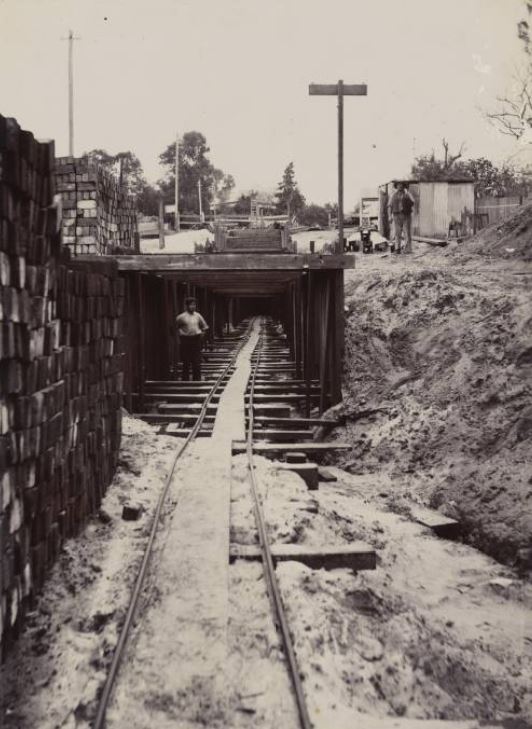
On Tuesday 12 July, 1898, train lines in the Perth region of Western Australia were severely damaged due to severe flooding from heavy rainfall. This caused hundreds of people to be cut off from food, water and proper shelter, with the tracks not able to be repaired for a number of days.
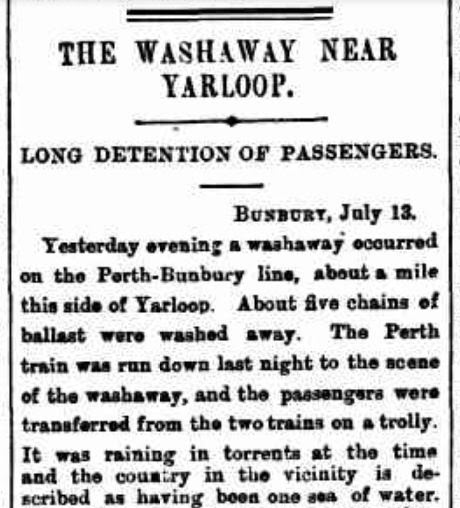
The “washaway near Yarloop” was a contentious issue in the newspapers at the time. Mainly because the rescuers and the passengers were not at all prepared for such a disaster, having no provisions such as food and drinking water. “It was raining in torrents at the time and the country in the vicinity is described as having been one sea of water.”
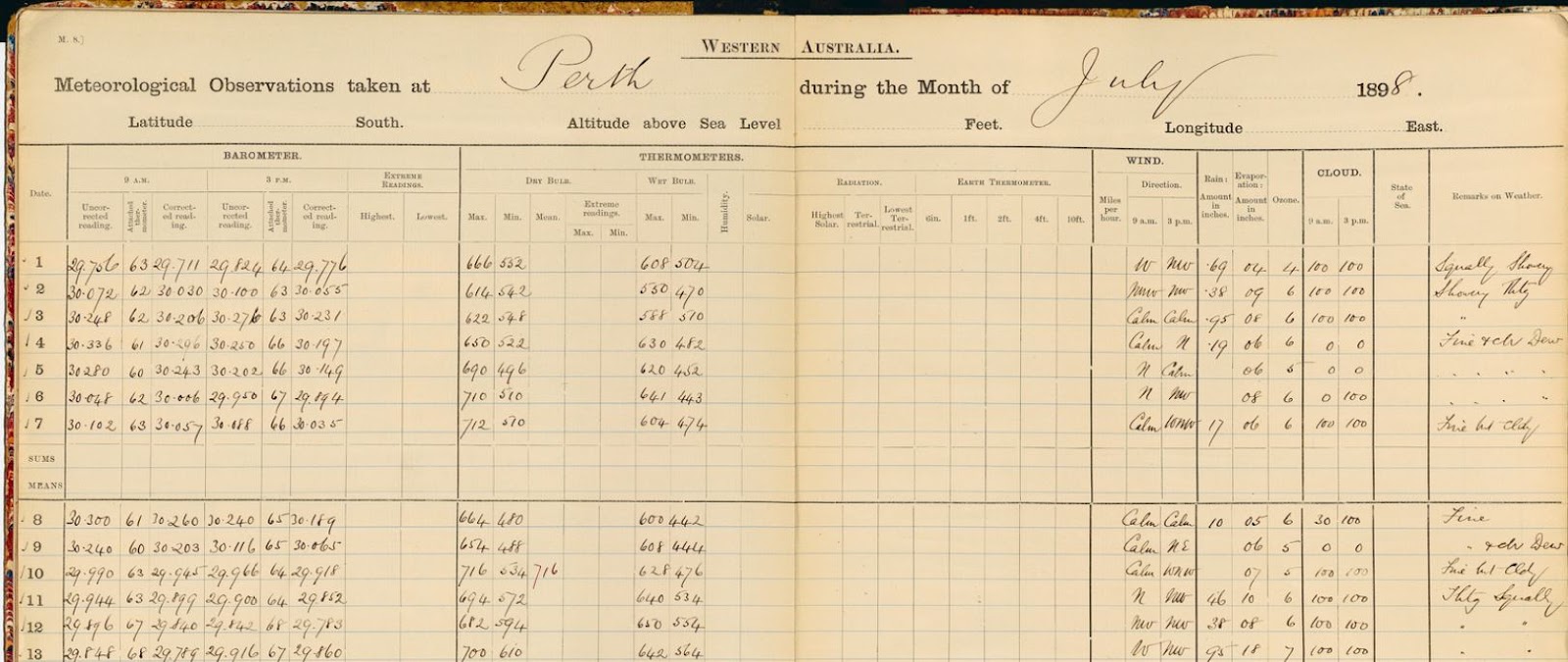
We recently completed a citizen science project to transcribe daily weather journals from Perth from 1880 to 1900. And, we found this storm in the recently recovered observations.
The Perth Gardens record for 11-13 July 1898 shows the following observations:
- Low pressure readings;
- Remarks ‘Threatening, Squally’ for all three consecutive days, and;
- Heavy rainfall over the three days.
In addition, a document ‘Results of Rainfall Observations made in Western Australia (1830-1827)’ highlights that there was indeed a significant rain event on 12 July 1898, sharing the washaway of the line at Yarloop and that the nearby town of Collie experienced a nine foot rise in the river within 24 hours, preventing traffic from passing.
Heavy rainfall caused difficulty for transport in Yarloop and Collie, south of Perth on 12 July, 1898. Source: Results of Rainfall Observations made in Western Australia (1830-1827), National Library of Australia.

What’s interesting from a meteorological perspective, is that the Government Astronomer of Perth sent a telegram to Adelaide to “warn ships coming westward” to Perth of “continued heavy weather on the coast and rough seas”.

The West Australian (Perth, WA) newspaper dated 12 July 1898. Source: Trove.
And looking at later newspapers, ships in the area did indeed report ‘heavy weather’ and ‘heavy seas’, including ‘strong headwinds’ and the ‘wind blowing with hurricane force’.
It’s also impressive to see an extensive report of the heavy rainfall by the Government Astronomer who was responsible for all the meteorological reports, Mr Cooke, at the Perth Observatory.
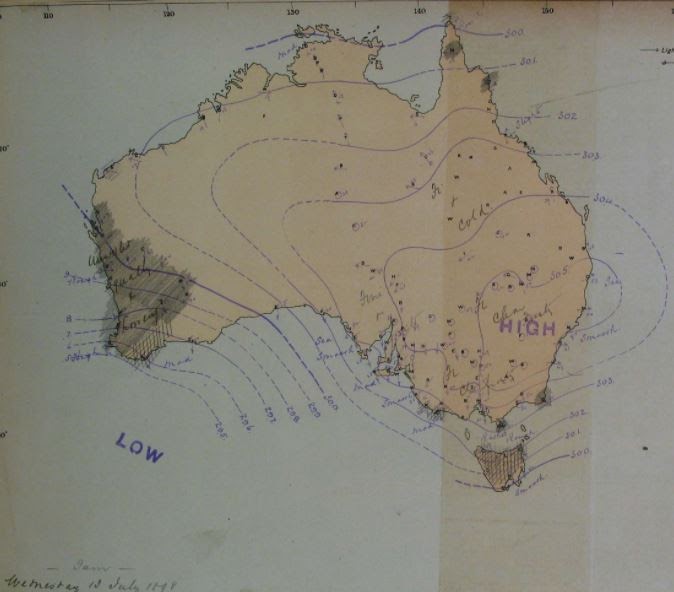
And what’s more, this storm event can be seen in reconstructed weather charts generated using the 20th Century Reanalysis dataset.
Pressure anomalies (20th Century Reanalysis) 9-12 July, 1898
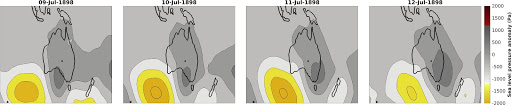
The 20th Century Reanalysis matches with historical synoptic maps written at the time by one of the pioneers of Australian meteorology, Sir Charles Todd.
Our recently completed citizen science project to transcribe weather journals from Perth means that we now have new daily pressure data that was previously unknown. This will help us better understand the conditions that lead to damaging storms similar to this one across the Perth region.
You can view the plotted preliminary barometer daily data graph from the Perth Gardens Zooniverse project on Zooniverse here.
The full analysis and results for the newly transcribed Perth Zooniverse data will take time, which we will publish in the scientific literature in due course and share on this website and in our e-newsletter. Don’t forget to sign up to our e-newsletter to stay informed.
If you are still interested in volunteering, we occasionally have tasks we need help with. For more information visit the ‘Citizen Science’ tab of this website.
 Climate History Australia